Tuesday, January 31, 2012

The Florida State Tree

Family: ARECACEAE the palm family

The palmetto, cabbage palm, or sabal palmetto is the state tree for both South Carolina and Florida. It is native to the Bahamas, Cuba, Florida and grows as far north as Virginia. Its habitat includes mesic temperate to tropical hammocks are often dominated by oaks but may have significant component of Sabal palmetto and occur from the panhandle down into the middle of the Florida peninsula. Here we let pictures do the talking for our fabulous state tree....
Palmetto or Sabal palmetto
A typical v-shaped Sabal palmetto leaf.

A Palmetto also graces the cover of a popular book about Florida trees by Gil Nelson.
Description: Straight trunked palm to 18 m in height Flowers: During June and July, abundant, small (.5cm), fragrant, white flowers are born on drooping branched panicles. Fruit: Round and black born in drooping clusters. Leaves:Fan shaped 1-2 meters long, deeply divided and V shaped, shiny green above and gray-green below. 
Similar to: Other palms, but the V shaped fan like leaves are pretty distinctive.

A clickable map of the larger palmetto palms on FSU grounds in Tallahassee.

American Elm - hanging on in America.

Family: Ulmaceae or the elm family which includes elms, sugarberries and hackberries


Ulmus americana
American Elm - American Elm
There are five species of elm growing wild in Florida. American elm is not the most common species on campus but it is widespread in Florida. The American elm is more or less susceptible to numerous diseases, including the Dutch elm disease (originally from Asia but first described in Holland) which was unintentionally introduced to the United States in the 1930s and killed millions of trees throught out the country - completely altering the ecology of its native range the eastern US . Disease resistant genetically modified varieties were bred and engineered and put on the market in the 1990s. It is the state tree for Massachusetts and for North Dakota. According to the Flora of North America Native American tribes used it for medicinal purposes, including coughs and colds, sore eyes, dysentary, diarrhea, broken bones, gonorrhea, and pulmonary hemorrhage, as a gynecological aid, as a bath for appendicitis, and as a wash for gunwounds. The most common elm species on campus is is the introduced ornamental Chinese elm, Ulmus parvifolia which has become naturalized in at least two counties in Florida and has self-sown seedlings coming up near plantings on campus.

 Description: Medium to large deciduous tree up to 40 m tall.Flowers: Small clustered in drooping catkins. Fruit: A flattened samara. Leaves:2-15cm long and 1-10 cm wide alternate, simple , two ranked, oval in shape. Margins doubly serrate, bases are not symmetrical - they are unequal either side of the mid-vein. Point tips. More important details: Bark light brown to gray, deeply fissured or split into plates. Wood soft. Branches pendulous, old-growth branches smooth, not winged; twigs brown, pubescent to glabrous. Trunk base is often supported by buttressed roots

Similar to: Similar to slippery elm (Ulmus rubra) but differs because the upper surfaces of the leaves are smoother, only slightly rough. Buds are chestnut brown, nearly glabrous, and pointed rather than purplish-brown, redhaired and blunt as is the case in its slippery cousin.


Ulmus americana has samaras (a type of winged seed).


Map of American Elm on FSU grounds in Tallahassee


Sunday, December 11, 2011

Get your gestalt on - oaks with lobed leaves at FSU

Family: FAGACEAE or the beech family which includes Oaks

There are 24 species of oak (trees and shrubs) in Florida, and 50-60 in North America north of the border so it is no small task to sort them all out. Acorns! When present these provide a good clue you are dealing with an oak. That is a good first step (if they are present at the time of year that you are looking). However more than few of the deciduous oaks look superficially similar, so you need to be pretty sharp to distinguish them. Here we look at a few examples that are multi-lobed (3-9+) and bristle tipped, these include Shumard oak and Nutall's oak. Mostly we have Shumard and Nutall's oaks planted on the FSU campus - and often in close proximity. Included for interest is turkey oak, there are none on campus but it is common in Tallahassee. In this posting we look at all three together to facilitate their comparison.


Quercus shumardii


Shumard oak - Quercus shumardii

Description: Medium to large deciduous tree up to 30 m tall.Flowers: Long narrow hanging catkins 14-18 cm long. Fruit: Acorn, solitary or in pairs, 1.5-2.5 cm long, cup shallow saucer shape and enclosing about a third of the nut. Leaves:7-15cm long and 6-12 cm wide alternate, simple and and lobed with 7 or sometimes more lobes, each lobe with several smaller secondary lobes, upper surfaces dark green, lower surfaces also shiny green but with small tufts of pubescence in the vein axils, old and fallen leaves with black spots on the surface.


Similar to: Distinguish from the other bristle tipped and lobed oaks by having only tufts of pubescence on lower leaf surface and by having straight rather than twisted petioles, and from the species most similar to it black oak Q. velutina by have more than sevel lobes. The shorter, relatively wide leaf distinguishes sterile specimens from Nuttall oak.


Map of Shumard oaks on FSU grounds in Tallahassee


Quercus nuttallii from the Louisiana State University website


Nuttall oak - Quercus texana and formerly Q. nuttallii

Description: A deciduous tree to 25+ m in height. Bark dark brown with flat ridges divided by shallow fissures. Twigs red-brown to gray. Flowers: Male flowers borne from tips in conspicuous hanging catkins. Fruit: Acorn 2-3 cm long, biennial; cup thin (scale bases visible on inner surface), deeply goblet-shaped with pronounced constriction at base. Leaves:alternate, simple 7-20 cm long x 5-13 cm with 6-11 asymetric lobes and 9-24 awns, lobes; lower leaf surfaces hairless except for conspicuous axillary tufts of tomentum, veins raised, upper surface not raised and free of hairs.


Similar to: Occurs only in cultivation in Florida but is native in nearby Alabama, Arkansas, Louisiana and Mississippi where it is common in wetlands. Bristles or awn like tips of leaves less acute or numerous than Shumard oak.

Map of Nuttall oaks on FSU grounds in Tallahassee


Quercus laevis
Turkey oak - Quercus laevis

Description: A small deciduous tree to 15m in height with grey furrowed and blocky bark. Flowers: Male flowers borne from tips in conspicuous hanging catkins 8-12 cm long. Fruit: Acorn 2-3 cm long, wide at base and tapering to apex. Leaves:alternate, simple 7-30 cm long with 3-7 deeply cut bristle tipped lobes, bases tapered, lower surfaces hairy in the vein axils and petioles twisted so the leaves are held verticle to the ground.

Similar to: Distinguished from southern red oak Q. falcata by a lack of rusty tomentose undersurface on leaves, but the tapered rather than U shaped leaf bases of post oak (Q. stellata) and from sand-post oak by the leaf lobes being pointed rather than rounded.


Map of turkey oaks on FSU grounds in Tallahassee (there are none known at this time)


Thursday, September 15, 2011

Japanese privet

Family: OLEACEAE the OLIVE family


Japanese privet Ligustrum japonicum is one of three types of privet on campus.

Ligustrum japonicum or Japanese privet is an evergreen shrub or small tree growing to 2–6 m. It is commonly planted as a hedge because of its foliage and fragrant flowers. The plant is dispersed by birds and is quite shade tolerant. This has helped it establish wild populations in Florida and elsewhere around the world.

Description: Japanese privet is an evergreen shrub or small tree growing to 2–6 m with smooth, pale grey-brown bark. Flowers: Fragrant white, with a four-lobed corolla 5–6 mm long; they are borne in clusters 7–15 cm long in early summer. Fruit: An oval drupe, 10 mm long ripening to purple black coler. Leaves: Opposite 5–10 cm long and 2–5 cm wide, glossy dark green above, paler glaucous to yellowish green below, thick and leathery textured, and entire.

Similar to: Japanese privet is closely related to the Chinese privet Ligustrum lucidum, differing in its smaller size (L. lucidum being as tall as 10 m), and elongated oval (not subglobose) fruit


Most of the Japanese privet on campus are not of sufficient size to be called a tree on FSU grounds in Tallahassee, this shows the larger specimens.

Wednesday, September 14, 2011

Quercus geminata Sand Live Oak

Family: FAGACEAE or beech family


Sand live oak, St. Joe's Bay.
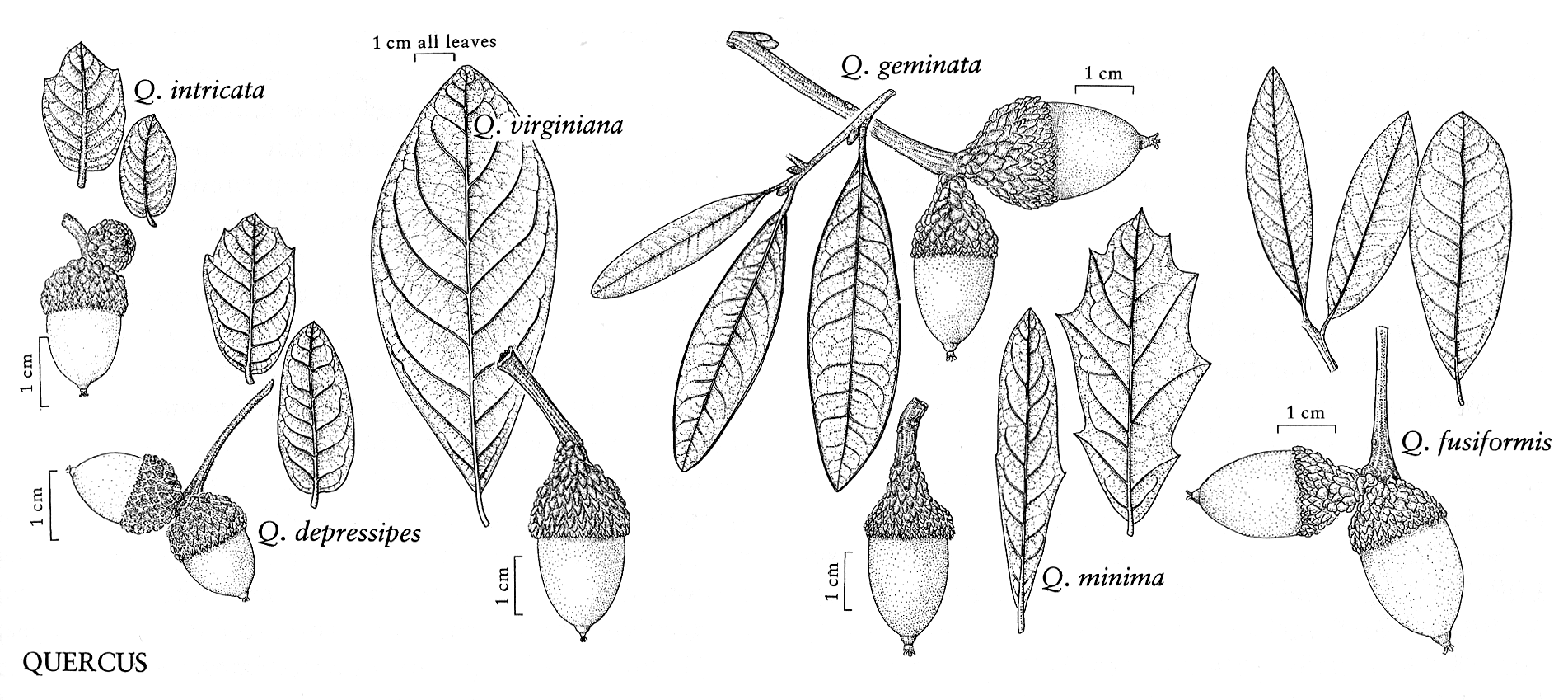
Sand live oaks Q. geminata are similar to live oaks Q. virginiana. Only a few are on Florida State University campus, and they can look similar when grown in similar conditions. It is widespread in southern Florida all the way to the Keys and from Louisiana to North Carolina. It is not restricted to beaches, and is also found in sand-pine scrub, coastal hammocks and similar habitats.


Description: Roughly ridged bark. Flowers: hanging catkins. Fruit: Shiny dark brown acorns often black at tip, 1-2 cm long. Leaves:alternate, simple and entire, thick and leathery 2-12cm long x 0.5-4 cm wide, dull grey below.

Similar to: Sand live oak, (Quercus virginiana) which does not have depressed veins and revolute leaf margins (looking like a boat when looked at from the bottom). The bark is not as rough either.


Add caption
Flora of North America Illustrations including both Sand Live Oak and Live Oak


See specimens in the FSU herbarium.


Map of sand live oaks on FSU grounds in Tallahassee


Crape myrtle or Lagerstroemia indica


Family: LYTHRACEAE the pomegranite and purple loosestrife family


Crepe myrtle or Lagerstroemia indica

Crape myrtle is the most common ornamental tree or large shrub on campus. Originally from Asia this plant is a popular ornamental in Florida and beyond. There are various >30 cultivars which were selected for their flower form and timing, plus disease resistance (especially against powdery mildew).
Description: Deciduous shrub or small tree to 8+ m in height with twisted branches and smooth brown bark. Flowers: a showy panicle (branched cluster of flowers) about 30 cm long. Colors white, pink, red or purple. Fruit: Egg shaped capsule. Leaves:Opposite or alternate, simple, mainly elliptic 2-7 cm long 1-4 cm wide.

Similar to: Pretty distinctive, not many similar plants.


Winged seeds of crape myrtle Photo: Steve Hurst. Provided by ARS Systematic Botany and Mycology Laboratory. United States, FL.


A clickable map of crape myrtle on FSU grounds in Tallahassee.

The Hollies - on campus

Family: AQUIFOLIACEAE the holly family


Holly or Ilex vomitoria though we are considering all the types on the FSU campus in this posting.


The Holly (Ilex) genus is popular among landscape architects, nurserymen and home gardeners. Botanists recognize approximately 470 taxa including 20 American Holly species, 120 Oriental species, and nearly 200 varieties of the English Holly. Many of the cultivars establish wild self-sustaining population in fields and near planted areas. The fruit are commonly dispersed by frugiverous birds. Shrubs or trees, mostly evergreen. Not all hollies have spiny leaves like the ones we associate with Christmas wreaths. There are least 5 varieties or species of tree sized hollies on campus.

Description: Shrub or small tree to 20+ m in height, mostly evergreen. Flowers: Flowers usually unisexual, usually 4-merous; petals connate at base. Stamens sometimes slightly united at base. Fruit: Usually globose and often bright red. Leaves:Usually alternate.

Similar to: This variable group of species likely to be similar to many other taxa but the fruit and flowers are often distinctive

 East Palatka Holly ( Ilex x attenuata 'East Palatka') growing at Rovetta Hall this is a natural hybrid between Dahoon Holly (Ilex cassine) and Amercian Holly (Ilex opaca) that was discovered in 1927 growing near East Palatka,Florida


A clickable map of all holly species and cultivars that have the size of a tree on FSU grounds in Tallahassee